Why Decorative Stone Props Matter in Luxury Retail Design
In luxury retail, every surface, material, and object communicates brand value before a single word is spoken or a price tag is seen. Decorative stone props — whether raw geological specimens, polished pedestals, carved architectural fragments, or sculpted abstract forms — carry an immediate sensory message of permanence, rarity, and craftsmanship. Unlike printed graphics or fabric installations that can look dated within a season, stone has an inherent timelessness that aligns perfectly with the brand language of high-end jewelry, fashion, cosmetics, and lifestyle stores.
The use of stone in luxury store environments has grown significantly as brands move away from sterile, minimalist interiors toward spaces that feel curated, tactile, and emotionally resonant. A rough-hewn chunk of rose quartz positioned beneath a necklace display, a stack of pale travertine slabs used as a platform for folded cashmere, or a polished black marble column anchoring a fragrance counter — each creates a visual hierarchy that draws the eye, slows the customer down, and frames the product as worthy of attention and investment.
Types of Decorative Stone Props Used in High-End Stores
The range of stone props available to luxury visual merchandisers and interior designers is broad, spanning natural geological specimens, fabricated stone objects, and composite stone materials. Choosing the right type depends on the brand aesthetic, the product category being displayed, and the spatial scale of the retail environment.
Natural Geological Specimens
Raw and semi-polished natural stones such as amethyst geodes, quartz crystals, agate slabs, selenite towers, and calcite formations are used extensively in beauty, wellness, and jewelry retail. These specimens are valued for their authenticity — no two pieces are identical — which reinforces a narrative of exclusivity. A large amethyst geode placed at the entrance of a boutique immediately signals a connection to natural luxury and sets an aspirational tone for the entire shopping experience. Agate slabs with their translucent banding patterns serve as elegant product platforms, particularly for small-format items like rings, perfume bottles, or lip products.
Polished and Carved Stone Objects
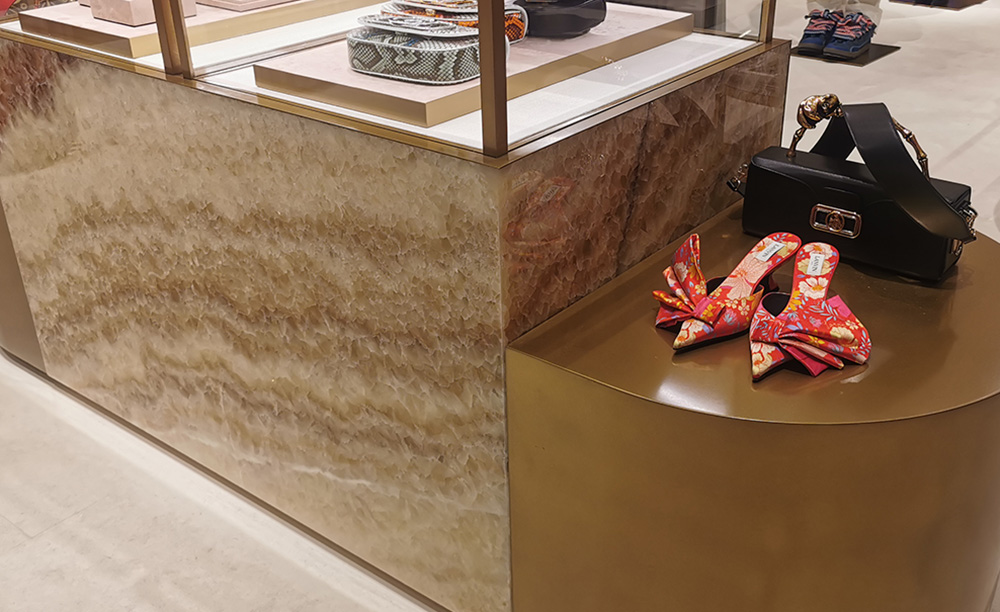
Fabricated stone props include polished spheres, carved pedestals, geometric forms, cylindrical columns, stepped risers, and abstract sculptures produced from marble, granite, onyx, travertine, and limestone. These objects offer the luxury of stone with the precision of controlled fabrication, making them ideal for brand-specific installations where consistency across multiple store locations is required. A fashion house rolling out a global window display campaign can specify identical Carrara marble pedestals to be produced and shipped to flagship stores in Paris, Tokyo, and New York, ensuring a unified visual identity while retaining the authentic material quality of natural stone.
Stone Composite and Engineered Stone Props
Engineered stone products — typically a blend of natural stone aggregate and resin binders — offer the visual appearance of premium stone at reduced weight and cost, with greater consistency in color and pattern. Brands working with large-scale installations, seasonal window displays, or temporary pop-up environments often choose engineered stone props for their practicality. These materials can be CNC-machined to very precise dimensions and custom finishes, enabling bespoke prop designs that would be prohibitively expensive in solid natural stone.
Stone Types and Their Visual Impact in Retail Settings
Different stone varieties carry distinct aesthetic associations and work better in some retail contexts than others. Understanding the visual language of each material allows visual merchandisers to make precise, intentional choices.
| Stone Type |
Visual Character |
Best Retail Application |
| Carrara Marble |
White with grey veining; classical elegance |
Fine jewelry, haute couture, cosmetics |
| Black Marquina Marble |
Deep black with white veins; dramatic contrast |
Watches, menswear, premium spirits |
| Travertine |
Warm beige tones with natural pitting; organic warmth |
Lifestyle, home goods, leather accessories |
| Onyx |
Translucent with banding; glows when backlit |
Fragrance counters, illuminated displays |
| Rose Quartz |
Soft pink translucency; feminine and ethereal |
Beauty, skincare, bridal jewelry |
| Lava Stone / Basalt |
Matte dark grey; industrial and refined |
Streetwear luxury, tech accessories, menswear |
Strategic Placement of Stone Props on the Retail Floor
Knowing which stone to use is only half the challenge — placement determines whether the prop enhances the product or competes with it. In luxury retail, stone props serve three primary spatial functions: anchoring, elevating, and framing. Each requires a different approach to scale, positioning, and lighting.
Anchoring Zones and Focal Points
Large stone props — geode halves, sculptural boulders, or monolithic slabs — are used to anchor key areas of the store such as entrances, central displays, or the end of a sightline. These statement pieces act as destination objects that draw customers deeper into the space. A geode weighing several hundred kilograms placed at the entrance of a high-end jewelry boutique communicates geological rarity at human scale, setting an expectation of exceptional objects throughout the store. For this type of anchoring use, the stone itself becomes part of the retail architecture rather than a secondary prop.
Elevating Products on Stone Platforms
Smaller stone props — stepped marble risers, flat agate platforms, polished onyx blocks, or carved pedestals — elevate individual products or small product groupings. This use is particularly effective in jewelry, watch, and fragrance retail where the product is small and needs to be lifted to eye level and framed with visual contrast. A single watch placed on a black granite cylinder, lit from above, communicates far more value than the same watch lying flat on a glass shelf. The stone prop creates a miniature stage for the product and physically separates it from surrounding items, reinforcing the sense that it deserves focused attention.
Framing Products in Window Displays
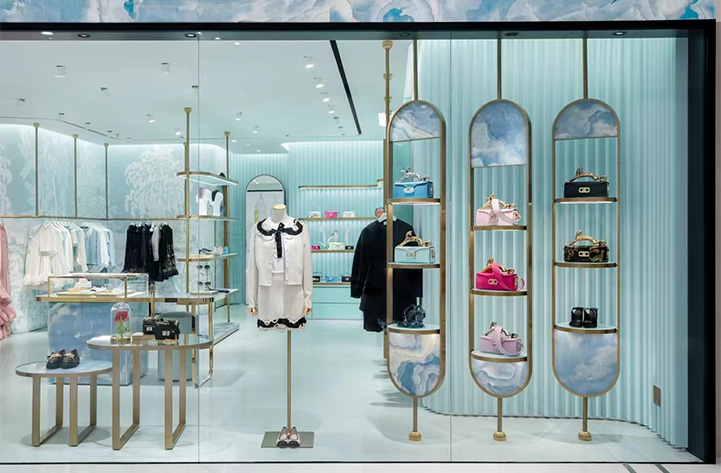
Window displays represent the most visible and competitive space in luxury retail. Stone props used in window installations must read clearly from a distance of several meters and communicate material quality even through glass. Stacked travertine slabs creating layered terrain, marble columns arranged asymmetrically, or raw stone fragments grouped around a single hero product — all of these compositions use the visual weight and texture of stone to create contrast with the lighter, more delicate merchandise they surround. The stone grounds the display, preventing it from looking ephemeral or insubstantial.
Lighting Techniques That Maximize Stone Prop Impact
Stone props perform very differently under different lighting conditions, and luxury retailers invest significantly in lighting design to extract maximum visual value from their material choices. Several techniques are particularly effective:
- Backlighting translucent stones: Onyx, selenite, and thin-cut agate are naturally translucent. Placing an LED panel or warm light source behind or beneath these materials causes them to glow from within, creating a dramatic luminous effect that draws immediate attention. This technique is especially effective for fragrance and skincare display counters.
- Directional spotlighting on textured surfaces: Rough or natural stone surfaces — such as the crystalline interior of a geode or the ridged surface of a split travertine slab — respond dramatically to directional light. Raking light cast at a low angle across the surface creates deep shadows in the texture, emphasizing dimensionality and reinforcing the impression of natural authenticity.
- Contrast lighting between stone and product: Positioning a warm spotlight on the product while the stone prop remains in slightly lower ambient light creates a visual hierarchy that keeps the merchandise as the primary object of focus. The stone provides the context and prestige; the product receives the luminous emphasis.
- Color temperature matching: Warm-toned stones like honey onyx, golden travertine, or amber calcite respond best to warm white light (2700–3000K), which enriches their natural color. Cool-toned stones like white marble or grey granite read cleanest under neutral to cool white light (3500–4000K), which preserves their crispness without introducing unwanted warmth.
Sourcing and Commissioning Stone Props for Luxury Retail
Sourcing high-quality decorative stone props requires working with suppliers who understand both the material properties of stone and the visual standards of luxury retail. Generic stone props purchased through standard home décor wholesalers rarely meet the quality thresholds demanded by premium brands. There are several important considerations when sourcing or commissioning stone props at a luxury level:
- Material provenance and documentation: Premium brands increasingly require suppliers to document the origin of natural stone, particularly for rare varieties. Provenance adds narrative value and satisfies growing customer interest in responsible sourcing. Knowing that a display agate came from a specific mine in Brazil or that a marble pedestal was quarried in Tuscany becomes part of the brand story.
- Custom fabrication capabilities: For brand-specific installations, work with stone fabricators who offer CNC cutting, custom finishing (brushed, honed, polished, sandblasted), and bespoke shaping. This ensures props match precise dimensional specifications and finish standards across multiple store locations.
- Weight and structural load assessment: Large stone props can weigh hundreds of kilograms. Before specifying a monolithic stone element for a display table or suspended installation, confirm that the retail floor, furniture, or fixture can safely support the load. Work with the store's structural engineer if significant weight is involved.
- Seasonal rotation and storage: Some luxury brands rotate stone props seasonally alongside broader visual merchandising updates. Planning for safe storage of large or fragile natural specimens requires padded crating, climate-controlled storage, and careful handling protocols to prevent chipping or fracture between display cycles.
Decorative stone props occupy a unique position in luxury retail design — they are simultaneously functional display tools and expressive objects in their own right. When selected with material intelligence and deployed with spatial precision, they do something that no digital screen or printed graphic can replicate: they place something genuinely ancient, rare, and irreplaceable in the same physical space as the customer, creating an atmosphere of exceptional quality that luxury brands depend on to justify their positioning and inspire purchase decisions.



 English
 Français
 عربى
عربى italiano