Why a Round Marble Dining Table Remains a Timeless Choice
A round marble dining table occupies a unique position in interior design — it combines the organic, irreproducible beauty of natural stone with a form that has proven its functionality and aesthetic staying power across centuries of domestic and hospitality design. Unlike rectangular or oval tables, the round format eliminates head-of-table hierarchy, encouraging equal, face-to-face conversation among all seated guests. Paired with the luxurious visual weight of a marble top, the result is a dining piece that commands attention in any room while remaining genuinely practical for everyday use.
The enduring popularity of round marble dining tables is not merely a matter of fashion. Marble's natural veining patterns mean that no two tables are ever identical — each slab carries a geological signature formed over millions of years that no manufactured material can authentically replicate. For homeowners and interior designers seeking a centerpiece that combines craftsmanship, permanence, and distinctive visual character, the round marble dining table consistently delivers on all three counts. Understanding how to select, size, style, and care for one correctly transforms a significant purchase into a long-term investment in the quality of a living space.
Marble Types Commonly Used in Round Dining Tables
The type of marble used for a dining table top determines its visual character, background color, veining intensity, surface hardness, and maintenance demands. Selecting the right marble variety for your aesthetic goals and lifestyle is the single most important decision in the entire buying process.
Carrara Marble
Quarried in the Apuan Alps of Tuscany, Carrara marble is the most widely used marble in furniture and architecture worldwide. Its characteristic white to blue-grey background with soft, feathery grey veining creates an approachable elegance that suits both contemporary and classical interiors. Carrara is relatively abundant compared to rarer marble varieties, which makes it more accessible in price while still delivering authentic natural stone quality. It has a moderate hardness rating and is more susceptible to etching from acidic substances than harder stones, making regular sealing important for dining table applications.
Calacatta Marble
Calacatta marble is often confused with Carrara but is distinctly different in character and considerably rarer. It features a brighter, crisper white background with bold, dramatic veining in gold, beige, or deep grey — sometimes running in sweeping, branching patterns across the entire slab. The contrast between Calacatta's white ground and its pronounced veining creates a more striking visual statement than the softer appearance of Carrara. Because of its rarity and visual impact, Calacatta is the premium choice for statement dining tables in high-end residential and hospitality projects, and it commands a significantly higher price per slab.
Emperador Marble
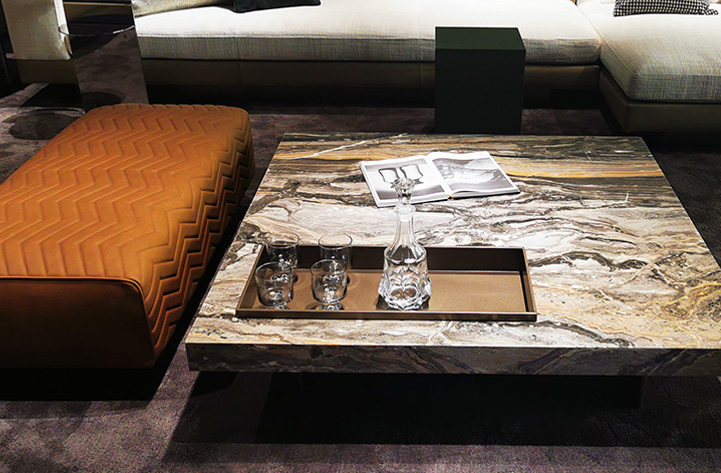
Emperador marble originates from Spain and presents in warm brown to dark chocolate tones with fine white or gold veining networks running throughout the stone. Dark Emperador is particularly suited to dining rooms with warm wood tones, leather upholstery, or richly colored walls, where a white marble top might create too stark a contrast. Its darker background also offers a practical advantage at the dining table — minor marks and stains are far less visible than on light-colored marble, making maintenance less stressful in active family environments.
Nero Marquina Marble
For interiors favoring dramatic contrast and a bold, contemporary aesthetic, Nero Marquina — a deep black marble with fine white veining from the Basque region of Spain — delivers exceptional visual impact. A round Nero Marquina table top on a polished brass or white lacquer pedestal base is one of the strongest design statements available in residential furniture. Its dark surface, however, shows dust and fingerprints more readily than lighter marbles, requiring more frequent surface wiping to maintain its showroom appearance.
Choosing the Right Table Diameter for Your Dining Space
Diameter selection is a practical science, not a matter of personal preference alone. A table that is too small for the room feels lost and inadequate; one that is too large blocks circulation paths and makes reaching across the table uncomfortable. The following guidelines provide reliable starting points for matching table diameter to both room size and seating capacity.
| Table Diameter |
Comfortable Seating |
Minimum Room Size |
Best Application |
| 80 cm (31 in) |
2 persons |
2.6 m × 2.6 m |
Apartment breakfast nook, bistro corner |
| 100 cm (39 in) |
4 persons |
3.0 m × 3.0 m |
Small family dining room, urban apartment |
| 120 cm (47 in) |
4–5 persons |
3.4 m × 3.4 m |
Standard family dining room |
| 140 cm (55 in) |
6 persons |
3.8 m × 3.8 m |
Generous family dining, open-plan living |
| 160 cm (63 in) |
6–8 persons |
4.2 m × 4.2 m |
Formal dining room, entertaining-focused homes |
The standard rule for circulation clearance is to allow a minimum of 90 cm between the table edge and any wall or fixed furniture — enough for a person to be seated comfortably with 45 cm of chair depth plus 45 cm of passing space behind. In rooms where the table will be accessed from multiple sides simultaneously during service, increasing this clearance to 110 cm significantly improves comfort. Always measure your actual room with tape before confirming a table diameter, as floor plans drawn to scale frequently reveal that the room is smaller than remembered.
Base Styles and Their Impact on Aesthetics and Function
The base of a round marble dining table is as important to its overall character as the top itself. The base determines seating comfort, leg room, visual weight, structural stability, and stylistic compatibility with the surrounding interior. The most common base configurations each carry distinct advantages and design implications.
Single Pedestal Base
The pedestal base — a single central column flaring into a platform foot — is the most popular base style for round marble dining tables and for good practical reason. With no corner legs to navigate, seating capacity is maximized and every chair can be positioned at any point around the table's perimeter without restriction. A pedestal base also offers excellent under-table legroom and allows chairs to be pulled in fully, which improves posture and eating comfort. Pedestal bases are available in a wide range of materials and profiles, from slim tulip-style columns in cast aluminum or polished stainless steel to chunky fluted marble or terrazzo pedestals that create a cohesive all-stone aesthetic.
Four-Leg Base
Four-legged bases — whether straight, tapered, splayed, or hairpin in profile — add a structural expressiveness to the table that a pedestal cannot provide. They are particularly well suited to mid-century modern, Scandinavian, and industrial design schemes where leg geometry is a prominent visual element. The practical trade-off is that corner legs limit free chair placement and can impede legroom for diners seated between legs, particularly at smaller diameters. For round marble tables of 120 cm or larger, four-leg bases generally provide comfortable seating between the legs, making the format more practical at larger scales.
Trestle and Cross Base
Trestle and cross-form bases — where two structural A-frames or crossed supports carry the marble top — create a strong graphic element beneath the table and are associated with contemporary and architectural interior aesthetics. These bases work particularly well in large open-plan spaces where the base structure is visible from multiple angles and contributes to the room's visual composition. In steel or brushed brass finish, a cross base under a white marble top produces one of the most striking combinations available in modern dining furniture.
Natural vs. Engineered Marble: Understanding the Difference
The market for round marble dining tables includes both genuine natural marble tops and engineered marble alternatives — sometimes sold as "cultured marble," "sintered stone," or "porcelain marble-effect" — and buyers should understand the real differences before committing to a purchase. Natural marble is quarried stone, cut and polished directly from geological deposits. Each slab is genuinely unique, with veining patterns, color gradations, and surface character that cannot be exactly replicated. Its authenticity is part of its value, both aesthetically and in terms of the long-term desirability of the furniture piece.
Engineered alternatives such as sintered stone — produced by compressing natural minerals under extreme heat and pressure — offer significantly higher resistance to staining, etching, scratching, and heat than natural marble. They are manufactured in consistent, repeatable patterns and are available at a lower price point. For households with young children, heavy daily use, or limited appetite for the maintenance requirements of natural stone, a high-quality sintered stone top in a marble-effect finish is a genuinely practical and visually convincing option. The distinction matters most to those for whom the provenance and authenticity of natural stone is part of the purchase's emotional and investment value.
Caring for a Round Marble Dining Table Day to Day
Marble requires more mindful maintenance than most other dining table materials, but the effort involved is not as onerous as its reputation sometimes suggests. With a few consistent habits, a marble dining table will retain its polished beauty for decades. The following care practices address the most common sources of marble damage in dining environments:
- Seal the Surface Regularly: Apply a penetrating stone sealer to the marble top every 6 to 12 months depending on use intensity. Sealing fills the microscopic pores in the stone surface, dramatically reducing the rate at which liquids and oils are absorbed. Use a sealer rated specifically for polished marble, as products formulated for granite or unpolished stone may alter the marble's surface sheen.
- Wipe Spills Immediately: Acidic substances — including wine, citrus juice, vinegar, coffee, and carbonated drinks — etch polished marble surfaces on contact, leaving dull spots that penetrate below the surface polish. Blot spills with a soft cloth immediately rather than wiping, which spreads the liquid across a larger area. Even sealed marble is not acid-proof, only acid-resistant.
- Use Coasters, Placemats, and Trivets: Place coasters under all glasses and cups, placemats under plates, and trivets under hot dishes. While marble has reasonable heat tolerance, thermal shock from very hot cookware can cause surface cracking in thinner tops. Coasters also prevent water rings from glasses with condensation on the exterior.
- Clean with pH-Neutral Products Only: Use only pH-neutral stone cleaners or plain warm water with a soft microfiber cloth for routine cleaning. Never use vinegar, lemon-based cleaners, bleach, or standard bathroom or kitchen spray cleaners on marble — all are acidic or alkaline enough to etch or discolor the surface over time.
- Address Etching with Professional Re-Polishing: If etch marks or dull patches develop despite preventive care, a stone restoration specialist can re-hone and re-polish the affected area, restoring the surface to its original finish. This process removes a microscopic layer of stone and is effective for superficial damage, though it is not a substitute for daily preventive care.
- Protect During Moves or Renovations: Marble is strong in compression but relatively brittle under bending and impact loads. When moving a round marble table top, always carry it vertically rather than horizontally to prevent flexural stress cracking, and use furniture blankets to protect the polished edges from chipping against door frames or walls.
Styling a Round Marble Dining Table in Different Interior Schemes
One of the most compelling attributes of a round marble dining table is its genuine versatility across interior design styles. With thoughtful chair selection and accessory choices, the same marble top can read as classically European, minimalist Scandinavian, warm Mediterranean, or coolly contemporary depending on how it is styled in the room.
In a contemporary minimalist interior, a white Carrara or Calacatta top on a matte black steel pedestal base, surrounded by upholstered dining chairs in a single neutral tone and illuminated by a sculptural pendant light positioned directly above the table center, creates a composition that is both restrained and visually rich. The marble provides all the texture and pattern the space needs without requiring decorative accessories on the table surface itself.
For a warmer, more layered aesthetic — suited to transitional or Mediterranean-influenced interiors — an Emperador brown marble top paired with natural oak or rattan-back chairs, warm brass candlestick holders, and linen table runners introduces a tactile, organic quality that makes the marble feel welcoming rather than formal. The key principle in any styling approach is to let the marble's natural pattern serve as the visual anchor of the composition and select surrounding elements in materials and colors that complement rather than compete with the stone's inherent character.



 English
 Français
 عربى
عربى italiano